




Imagine running an e-commerce business in the early 2000s and being told that your store could only accept payments from customers using one specific bank. Anyone with a different bank account simply couldn’t buy from you. That was the Web2 problem that payment processors like Stripe and PayPal ultimately solved. Today, Web3 faces an analogous, and arguably more complex, crisis.
In 2026, the blockchain ecosystem has splintered into dozens of Layer-1 and Layer-2 networks — Ethereum, Solana, Avalanche, Base, Arbitrum, Optimism, Polygon, StarkNet, Monad, and hundreds more. Each network operates as its own ecosystem with its own tokens, liquidity pools, developer tools, and user base. For end users, this means they are managing multiple wallets and repeatedly bridging assets.
For businesses building on-chain, the consequences are far more punishing.
This article explores
- What causes chain abstraction to become necessary?
- The real dangers of operating in a multichain internet economy,
- The solutions currently available, and which approach is best positioned to serve the businesses building Web3’s next generation.
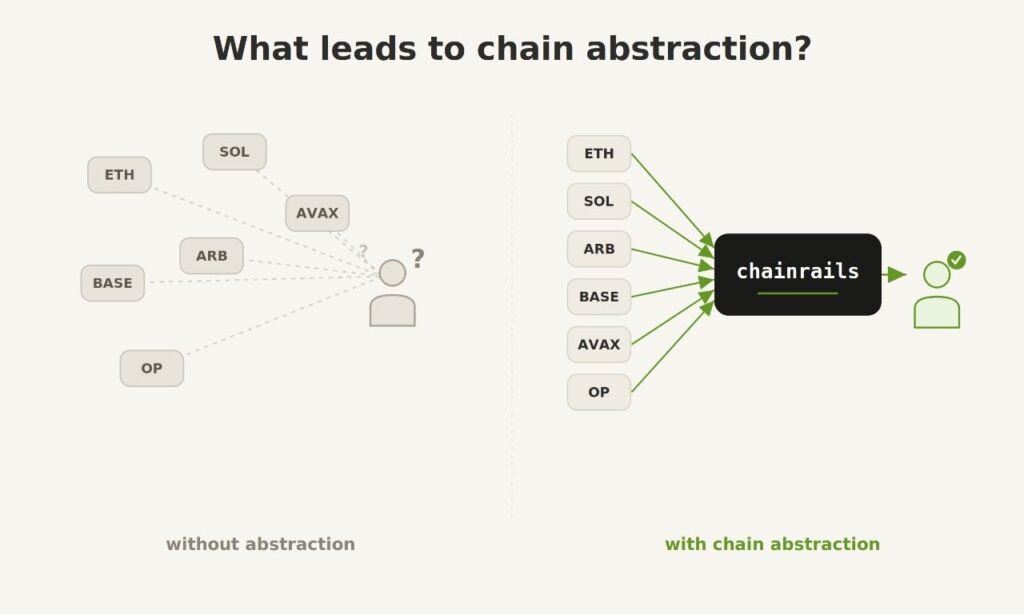
What Leads to Chain Abstraction?
The need for chain abstraction did not arrive suddenly. It is the predictable consequence of how blockchains have evolved.
The Proliferation of Chains
The blockchain industry’s growth has always been tied to specialization. Ethereum proved the concept of smart contracts, but its scalability limits drove the emergence of alternative Layer-1 chains and, eventually, Layer-2 rollups. Developer tooling has made it increasingly easy to launch bespoke L1s and L2s. Hundreds of rollups launched in 2024 alone, and the growth curve has steepened in 2025, with every major ecosystem spinning up dedicated networks.
This proliferation made sense at the infrastructure level. Different chains optimize for different trade-offs: some prioritize throughput, others prioritize decentralization, EVM compatibility or low fees. But the unintended consequence was a deeply fragmented experience for both users and developers.
Liquidity Siloing
One of the most structurally damaging effects of multichain proliferation is liquidity fragmentation. Every blockchain operates its own liquidity silos — USDC on Ethereum is not the same as USDC on Solana or Avalanche. The same asset, representing the same dollar value, effectively exists as a different object on each chain. Both are incompatible, non-transferable without friction, and accounted for separately.
This means that a business deployed on Base cannot natively accept funds from a user whose assets sit on Solana. Developers are forced to build for specific chains’ ecosystems, while users struggle with the costly, time-consuming art of bridging and managing chain-specific balances. This is a fundamental barrier to mainstream adoption.
The Developer Experience Problem
For developers, the multichain landscape creates an enormous maintenance burden. Building and maintaining integrations with multiple blockchains is complex, time-consuming, and expensive. Each chain has its own unique architecture, token standards, and developer tools. While some products truly need multichain logic, most apps don’t — they just want to accept deposits and payments from users wherever those users already are, without managing 10+ different infrastructures.
The technical debt compounds over time. Teams that want to be accessible to users across chains must deploy separate smart contracts, manage separate liquidity pools, maintain separate monitoring systems, and build separate bridge integrations for each new network they want to support. In a space moving as fast as Web3, this is an enormous tax on product velocity.
The User Experience Collapse
From a consumer standpoint, the current state of Web3 asks too much. The current Web3 ecosystem forces users to navigate multiple chains and manage various wallets to fully engage with different networks fully. Protocols often select chains based on co-marketing efforts, market sentiment, and total value locked (TVL), rather than focusing on technology or innovation.
A user on Solana who wants to use a DeFi application deployed on Arbitrum must acquire a compatible wallet, bridge their funds (and hope the bridge works), pay gas fees in the destination chain’s native token, and then interact with the app. Each step is a potential drop-off point. Cross-chain bridge volumes have periodically reached tens of billions of dollars per month during peak cycles, and stablecoin transaction volumes alone hit $33 trillion in 2025. Users are constantly moving assets between chains. The tooling just hasn’t caught up to make it seamless.
These compounding forces (chain proliferation, liquidity siloing, developer burden, and poor UX) are precisely what make chain abstraction not just desirable but necessary.
The Dangers of Operating a Business in a Multichain Internet Economy
For companies building in Web3, particularly those handling payments, deposits, withdrawals, or treasury operations, the multichain landscape introduces operational risks.
Liquidity Risk and Capital Inefficiency
Businesses operating across multiple chains must maintain separate liquidity pools on each network to ensure smooth operations. During periods of high volatility or demand, bridges may face liquidity crunches. A business that has fragmented its treasury across five chains to serve users on five networks must now manage five separate liquidity pools, write lines of code for five separate networks, operate five separate monitoring systems, and it still cannot guarantee that a user on chain six will be served.
This model does not scale. It creates idle capital sitting in suboptimal positions, increases accounting complexity, and multiplies the attack surface for treasury theft or mismanagement.
Revenue Loss from User Friction
Every additional step a user must take before completing a payment is a potential conversion failure. When a Web3 business accepts payments only on one chain, it turns away every user whose assets live on a different network. When it tries to support multiple chains, it introduces UX complexity that drives abandonment.
Fragmentation has manifested in several layers of systemic inefficiencies that slow Web3’s growth, including technical inefficiencies, in which developers must rebuild identical infrastructure across different chains, draining resources and stifling innovation, and incentive inefficiencies, in which blockchains are trapped in self-defeating cycles of ecosystem bootstrapping.
For a payments business such as a DeFi protocol or a Web3 marketplace, this friction directly translates to lost revenue.
Regulatory and Compliance Complexity
Operating across multiple chains and fiat rails increases regulatory surface area, as businesses must navigate an evolving compliance landscape across both multichain bridge infrastructure and fiat on/off-ramp providers. While bridges may introduce regulatory uncertainty around money transmitter classification across jurisdictions, the greater friction often comes at the fiat layer, where each payment processor, banking partner, or ramping provider requires separate KYB, licensing, and jurisdiction-specific compliance checks, resulting in fragmented and repetitive onboarding.
Developer Burnout and Talent Costs
Maintaining multichain infrastructure requires specialized expertise across multiple ecosystems. A Solana developer is not automatically qualified to maintain an EVM contract on Arbitrum, and vice versa. Teams must hire or train for each ecosystem they support, or accept subpar or sub-optimal quality. The ongoing cost of staying up to date with rapidly evolving tooling, security patches, and chain upgrades across multiple networks is enormous and is borne entirely by the business.
Available Solutions and Examples
Recognizing the severity of the problem, the ecosystem has produced a range of solutions, each occupying a different position on the abstraction stack.
Traditional Cross-Chain Bridges
The earliest solution to chain fragmentation was the cross-chain bridge. Bridges enable users to lock assets on one chain and receive equivalent representations on another. They work well for manual cross-chain transfers, but they introduce complexity for developers building applications that need to accept payments or deposits from users on multiple chains. Oftentimes, developers must still integrate with multiple bridges to cover different routes, manage route discovery and liquidity risks, and monitor transactions for completion and refunds, accounting for bridge-specific nuances.
Bridges are a necessary infrastructure, but they are not a business-layer solution.
Cross-Chain Aggregators
A layer above traditional bridges, aggregators provide unified interfaces that route transactions through the most optimal available bridge or liquidity pool. They abstract away the choice of bridge, handling route discovery automatically. Aggregators do an incredible job of simplifying access to multiple bridges and liquidity pools, providing a unified interface to route transactions through the best available paths. However, they are primarily focused on optimizing trade routing and liquidity access. Users or developers still need to deal with bridging risks, retries, transaction monitoring, and refunds. They are ideal for swaps and liquidity routing, but not optimal for business use cases like payments or deposits.
Aggregators represent a meaningful improvement over raw bridges in developer experience, but they still impose significant operational overhead on the builder.
Business-Layer Chain Abstraction: Chainrails
Sitting at the top of this stack is a category of solutions purpose-built for the business layer, and Chainrails is the most complete implementation of this approach currently available.
Chainrails eliminates fragmentation and friction. Build on the chain you prefer, and accept deposits and payments from any chain, in any token, or fiat currency through a single SDK. No redeployments. No custom bridge logic. No juggling liquidity. Just one integration that connects your app to users everywhere.
While bridges handle asset movement and aggregators optimize routes, Chainrails abstracts chains entirely from business interactions. Chainrails sits a layer above aggregators, abstracting away the entire bridging experience. It lets developers accept value from any chain, in any token, or even fiat, without managing bridges, liquidity, or settlements. Every transaction is modeled as an Intent, and Chainrails handles the execution behind the scenes.
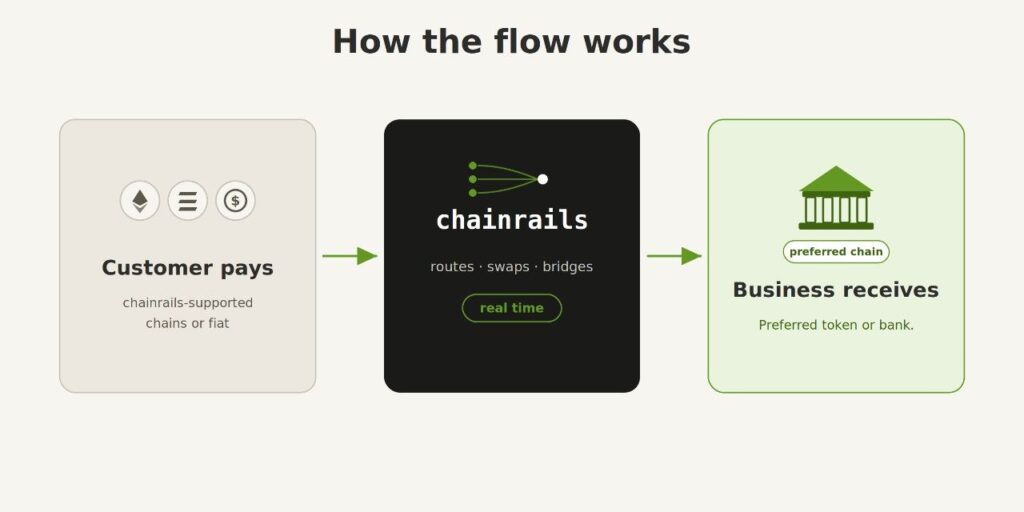
How the Flow Works
The practical workflow is three steps: a customer pays using any token on any chain (or via fiat) supported by Chainrails; Chainrails automatically routes, swaps, and bridges the funds in real time, optimizing for cost, speed, and reliability; and the business receives funds on its preferred chain in its preferred token, or directly to a bank account.
This means a DeFi app on Base can accept payments from a Solana user paying in SOL, a Nigerian user paying in naira via bank transfer, and an Ethereum user paying in USDT, all through the same integration, with no additional infrastructure required from the business.
Intent-Based Execution
At the core of Chainrails is an intent-based architecture. Developers no longer need to specify bridges, routes, and liquidity paths manually. Instead, Chainrails models every transaction as an intent. Developers declare what they want to happen; Chainrails determines how to make it happen across chains automatically, without additional developer input.
Settlement and Execution Speed
Chainrails uses relayer-backed infrastructure to enable fast cross-chain execution and reduce payment friction. Because liquidity is pre-funded across supported routes, transactions do not wait on traditional bridge settlement times. Instead, Chainrails handles routing and execution orchestration internally, allowing most transactions to complete in 15 to 20 seconds.
Regulation and Compliance
Chainrails reduces compliance complexity by abstracting requirements across supported geographies and service providers. Instead of requiring businesses to complete separate KYB and compliance processes for each individual ramping partner, Chainrails streamlines onboarding and ensures regulatory requirements are consistently met across jurisdictions.
What Developers No Longer Have to Manage
Rather than maintaining a patchwork of integrations, developers hand off the execution layer entirely. Including:
- Integrating separate bridges for each supported route
- Building and maintaining routing infrastructure
- Managing fragmented liquidity across networks
- Maintaining parallel payment systems across chains
With Chainrails, businesses interact with a single integration layer, while we handle everything beneath it.
Unified Multichain Integration
Chainrails acts as the unifier. This means that we surface a single SDK and API layer across supported ecosystems. As a result, teams can expand to new networks effortlessly, without redesigning their payment architecture each time the integration scales with the business.
Fiat On-Ramps
Chainrails also supports fiat on-ramps directly within the payment flow. For businesses operating in markets where the majority of users are not yet crypto-native (including much of Africa and Latin America), this is a critical capability. Users who don’t already hold crypto assets can still complete payments without friction.
Which Solution Is Best?
The quicker answer is: it depends on the use case. However, for Web3 businesses or any team building a product that needs to accept or send value, the layered comparison makes the answer fairly decisive.
| Solution | Best For | Limitations |
|---|---|---|
| Raw bridges | Manual asset transfers, DeFi power users | Complex integration, high security risk, developer overhead |
| Aggregators | DEXs, swap interfaces | Not designed for business payment flows, limited monitoring |
| Chainrails | Businesses accepting payments, withdrawals, and deposits. | Supports a limited number of chains. |
For a developer building a Web3 application that needs to handle payments or deposits, a DeFi protocol, a marketplace, a subscription product, a gaming platform, or a fintech app, Chainrails addresses the problem at exactly the right level of abstraction.
It does not ask the developer to understand bridge mechanics, manage liquidity, write monitoring logic nor does it ask the user to understand which chain they are on or what token they need to use. It accepts value from anywhere and delivers it wherever the business needs it.
The comparison is stark: bridges require high integration effort per bridge, with the developer managing routing and liquidity. Aggregators require moderate integration effort: the aggregator manages routing, while the developer still manages monitoring and refunds. Chainrails requires a single integration, with all routing, liquidity, monitoring, refunds, and fiat ramps handled automatically.
TL;DR
The blockchain ecosystem’s fragmentation problem is real, growing, and expensive, in developer time, user drop-off, security exposure, and missed revenue. Chain abstraction is a foundational requirement for Web3’s transition from a technically sophisticated niche to a mainstream economic layer.
Chain abstraction provides a single interface that enables users and developers to interact with multiple blockchains without needing to manage the complexities of each individual chain.
Among the solutions available today, Chainrails stands out as the most complete implementation for businesses. It operates at exactly the right layer of abstraction, which is above the plumbing of bridges and aggregators, at the level where business logic lives. Accepting deposits from any chain, settling to your preferred chain or bank, handling fiat and crypto equally, completing transactions in seconds, this is what payments infrastructure should look like.
Web3 businesses that want to serve users wherever they are, rather than only where they happen to be, cannot afford to build on fragmented infrastructure.
Chain abstraction is the answer.
Chainrails is the on-ramp.