



For other parts of the world, stablecoins may have come as an expansion to an array of products, but for the african demography it came as a solution to unsolved problems.
Numbers don’t lie. and in this case, it is undoubtedly glaring. Nairametrics for example has this to say:
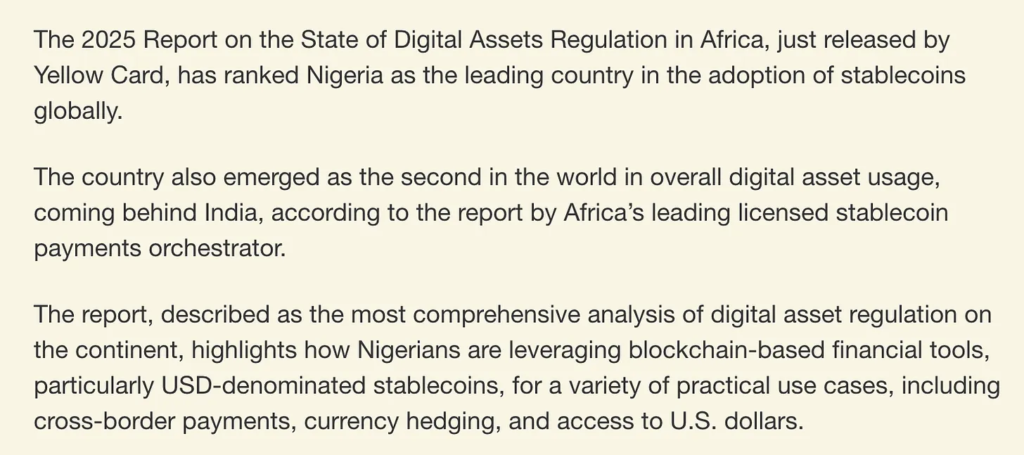
In a separate article here, that data is backed up:

That’s interesting. So what is driving this explosion?
Why Stablecoins Are Winning in Africa
Well, it is definitely not accidental, that’s for sure. What we can observe is a result of a number of forces converging at the same time. We can loosely categorize these users into 3 broad groups:
1. The normies
For many everyday users, stablecoins offer a singular use, to hedge against inflation. In economies where fiat currencies experience persistent inflation, holding savings in stablecoins has become a better alternative to navigating the complexities and restrictions of Trad-Fi, akin to a digital savings account.
2. Ecosystem Players
Beyond retail users, ecosystem players — the builders, the traders, the founders — more often than not hold a greater fraction of their port in stables. It’s risk management 101. No better way to retain fluidity and stability at the same time.
3. Freelancers
This is perhaps the most significant driving force. Across Africa, a growing talent pool earn income globally and receive payments across borders. This has led to an explosion of applications focused on “cross-border” payments, on-ramps, and off-ramps. Many of these startups are born in hackathons across different blockchain ecosystems which goes to show that the problem is real and the demand is still underserved.
I once read that “the presence of multiple competition to a product shows that the market hasn’t been dominated yet” and I couldn’t agree more. It is safe to say we can expect the rise of even more applications in this niche.
Capital on Standby: The Second-Order Effect
One often overlooked consequence of widespread stablecoin adoption is this: capital becomes deployable.
When users hold value in stablecoins, money is no longer “stuck” waiting to be converted, cleared, or approved. It is liquid. It is ready.
That capital starts asking questions:
- What prediction market can i gamble on my intuition?
- Which protocol should I test?
- Which e-commerce platform makes purchasing seamless?
- Which on-chain application actually works for me?
As DeFi continues to evolve and applications are deployed across multiple blockchains, this pool of ready capital becomes fuel for experimentation, adoption, and growth. But this experience is hindered by a recurring challenge.
Fragmentation Is the Real Enemy
As applications proliferate across chains, users increasingly face a familiar friction: complexity.
Different wallets. Different networks. Different bridges. Different gas tokens.
“If users have to worry about what chain your application is built on, you’ve already lost.”
That statement rings truer every day. Chain fragmentation, while technically impressive, often cuts users off rather than bringing them in. For the next wave of adoption — especially among users entering crypto through stablecoins — abstraction is no longer optional.
This is where orchestration layers like Chainrails become critical.
By removing chain-specific complexity and allowing users to focus on intent rather than infrastructure, systems like Chainrails align perfectly with how stablecoins are actually being used in Africa today: as tools, not toys.
For the average stablecoin user in Africa, none of this innovation matters if it comes with friction.
A freelancer in Lagos doesn’t want to think about whether their USDT lives on Tron or Ethereum. A small business receiving cross-border payments doesn’t care which chain offers the lowest gas fees that day. They just want money to arrive, get paid for their work, and move value when it is needed.
This is the gap Chainrails is built to close. Instead of asking users to navigate wallets, bridges, or networks, Chainrails focuses on intent: what the user wants to do, not how the blockchain executes it. Behind the scenes, it routes stablecoin transactions across chains, sources liquidity where it’s available, and handles execution complexity automatically.
For African users who rely on stablecoins as everyday financial tools this abstraction turns crypto from a technical system into a usable financial rail. In a region where stablecoins solve real-world problems, making them seamless is far more than a luxury; it is the difference between adoption and abandonment.
The Bigger Picture
Stablecoin adoption in Africa is continually on the rise.
Driven by real economic needs, powered by global connectivity, and sustained by practical use cases, stablecoins have quietly become one of the most impactful financial technologies on the continent.
Nigeria’s numbers are simply the clearest signal of something much larger: Africa is not waiting for the future of finance. It is actively building and using it.
And for that future, Chainrails is indispensable.